Safe drinking water from a shallow well, built in stages.
An open design for homes in the Philippines.
More than half of Filipino families buy their drinking water by the container from refilling stations. For a family of six, I estimate that costs about ₱8,700 to ₱23,200 a year. This page shows a way to make safe drinking water at home from a shallow well, starting small and upgrading over time.
One water path.
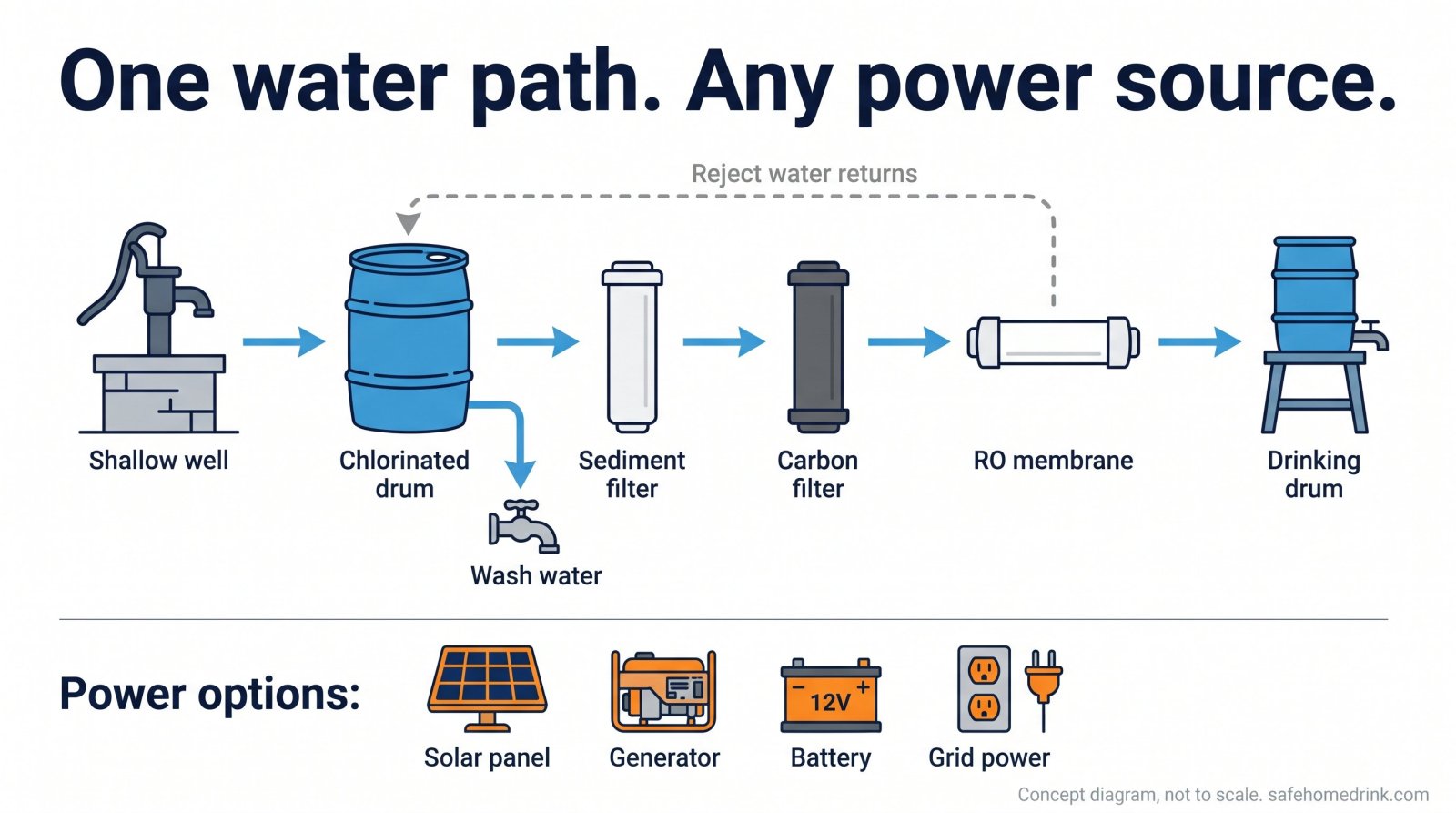
- Shallow well. The hand pump most homes already have.
- Chlorinated drum. A covered plastic drum, dosed with household bleach like a small pool. It also supplies wash water.
- Sediment and carbon filters. The carbon removes the chlorine so it cannot damage the membrane.
- RO membrane. RO means reverse osmosis: water is pushed through a membrane that holds back dissolved contaminants. The reject water returns to the drum, so nothing is wasted.
- Drinking drum. A small food-grade drum on a stand, with a faucet.
Any power source.
Every pump runs on 12 volts, so the power source can change without rebuilding the water side.
- Grid starter. A plug-in 12-volt adapter. The cheapest way to begin.
- Pedal backup. A pedal generator charging a battery, for brownouts.
- Solar upgrade. A panel, controller and battery, for homes with weak or no grid power.
- Generator. A fuel generator also works, because it only has to run the plug-in adapter or charge the battery.
Build in stages.
1
Drinking line on grid power
₱8,100 to ₱10,400
2
Automatic chlorine dosing and a wash-water pump
₱5,000 to ₱8,000
3
Motor drive on the hand pump
₱3,000 to ₱5,000
4
Solar panel and battery
₱17,000 to ₱28,000
At typical refill prices, I estimate stage 1 pays for itself in about a year.
Stage 1 parts list.
Philippine prices in pesos, checked in November 2026. 'Listed' is a price I found on a Philippine listing. 'Estimate' is my own figure because I found no local listing. Prices change, so check before buying.
200-liter blue plastic drum with lid, the cistern
₱900 to ₱1,300
Listed
60-liter food-grade drum with cover, for drinking water
₱700 to ₱800
Listed
Faucet for the drinking drum
about ₱100
Listed
Two clear 10-inch filter housings, each with a sediment cartridge
about ₱1,700
Listed
Carbon cartridge, 10-inch
about ₱160
Listed
RO booster pump, 75 gallons per day, 24 volts
about ₱1,900
Listed
24-volt plug-in power adapter for the pump
₱400 to ₱600
Estimate
RO membrane, 100 gallons per day, with its housing
₱1,000 to ₱1,600
Listed
Tubing, fittings, flow restrictor and check valve
₱500 to ₱800
Estimate
Float valve to stop the pump when the drum is full
₱150 to ₱300
Estimate
Chlorine and pH test strips
₱200 to ₱400
Estimate
Plain unscented household bleach
₱50 to ₱100
Estimate
Stand about 1 meter high, built from wood or hollow blocks
₱300 to ₱600
Estimate
Total
about ₱8,100 to ₱10,400
The first carbon cartridge goes inside one of the two filter housings in place of its sediment cartridge. Keep the spare sediment cartridge as a replacement.
The full system, drawn.
This drawing shows the system after all four stages, with the well motor and solar power added. Stage 1 uses only parts 5, 9 to 12 and 14 to 16, with the hand pump worked by hand and a plug-in adapter in place of the panel and battery.
- Shallow well, existing narrow pipe.
- Lever hand pump on a raised pedestal.
- Counterweight on the long lever.
- 12-volt gear motor, crank and rod, inside a guard.
- Cistern drum, 200 liters, covered and chlorinated.
- Bleach bottle and dosing pump.
- Float switch that stops the well motor when the drum is full.
- Wash-water pump, 12 volts.
- Sediment cartridge.
- Carbon cartridge, which removes the chlorine.
- RO feed pump, 12 volts.
- RO membrane.
- Reject water return line to the cistern.
- Drinking drum, 60 liters, food grade, on a stand.
- Float switch that stops the RO pump when the drum is full.
- Drinking faucet, gravity fed.
- Solar panel, 400 watts.
- Charge controller with low-voltage cut-off.
- Deep-cycle lead-acid battery, 12 volts.
- Wash line to taps and toilet.
Concept drawing for discussion, not for construction. Sizes and ratings are my estimates. Confirm them against a water test, the well depth and the parts you actually buy.
Where to buy the parts.
The numbers match the drawing above. I earn nothing from these links. A Philippine link marked 'search' opens a live search, so sellers and prices will vary. Amazon links are United States listings: check that the seller ships to the Philippines, and the shipping cost, before you order. Check that every part matches its description.
| No. | Part | In the Philippines | On Amazon |
|---|---|---|---|
| 2 | Hand pump | Lazada search | Amazon |
| 4 | Gear motor, 12 volts | Lazada search | Amazon |
| 5 | Cistern drum, 200 liters | Carousell listings · Lazada search | Amazon |
| 6 | Chlorine dosing pump | Lazada search | Amazon |
| 7 and 15 | Float switch | Lazada search | Amazon |
| 8 | Wash-water pump, 12 volts | Lazada search | Amazon |
| 9 | Filter housings, 10-inch, with sediment cartridge | Lazada store · Wilcon Depot | Amazon |
| 9 | Spare sediment cartridges | Shopee search | Amazon |
| 10 | Carbon cartridge, 10-inch | Carousell listings · Lazada search | Amazon |
| 11 | RO pump | Lazada listing, 24 volts · Shopee search | Amazon, 12 volts |
| 11 | Plug-in power adapter for the 24-volt pump | Lazada search | |
| 12 | RO membrane with housing | Lazada search · Shopee search | Amazon |
| 13 and 20 | Tubing and push-fit fittings | Lazada search | Amazon |
| 14 | Drinking drum, 60 liters, food grade | Carousell listings · Lazada search | Amazon |
| 16 | Drinking faucet | Price comparison | Amazon |
| 17 | Solar panel, 400 watts | Lazada search | Amazon |
| 18 | Charge controller, 30 amps | Lazada search | Amazon |
| 19 | Deep-cycle battery, 12 volts, 100 amp-hours | Lazada search | Amazon |
| Chlorine and pH test strips | Lazada search | Amazon | |
| Bleach, and wood or hollow blocks for the stand | Local store or hardware |
The pumps differ by source. The Philippine listing for part 11 is a 24-volt booster pump that needs its own plug-in adapter. The Amazon one is a 12-volt pump that suits battery and solar power.
Safety rules.
- Test the well water before building.
- Use new food-grade drums only. Never reuse a drum that held chemicals.
- Keep every drum covered and screened against mosquitoes.
- Replace the carbon filter on a fixed schedule.
Where this stands.
This is an open design, free to copy and improve. It has not yet been built and tested as a complete system, and the costs are my estimates. If you build one, I would like to hear how it went.